
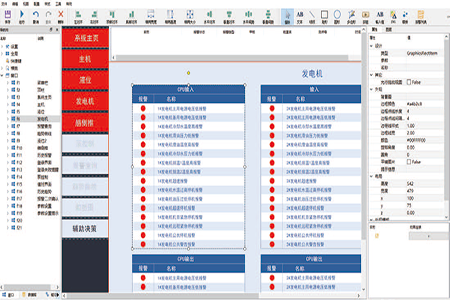
Real-time alarm handling: Data points support single-point alarms and composite alarms, enabling timely identification and handling of anomalies to generate alarm events. Single-point alarms employ threshold detection methods, triggering alerts when a data point exceeds preset thresholds to rapidly identify conspicuous anomalies. Composite analysis across multiple data points enhances accuracy in detecting complex anomalies. Delayed alarms are supported, triggering alerts after a lag following anomaly detection to minimise false positives. Alarms may be linked to deck stations for synchronised alerts, enabling immediate awareness of alarm locations and circumstances.
Graphical User Interface Development: Configuration software constitutes a software platform and development environment at the supervisory control level of automated control systems. It provides an excellent user development interface and straightforward operation through flexible and diverse configuration methods. Its pre-configured software modules readily implement and fulfil various supervisory control functions while simultaneously supporting computers and I/O devices from multiple hardware manufacturers. When integrated with highly reliable industrial control computers and network systems, it delivers comprehensive software and hardware interfaces to both the control and management levels.
Performance optimisation: By employing rendering optimisation, animation optimisation, memory management, event handling, and data structure algorithm optimisation principles and techniques, we enhance interface rendering speed, responsiveness, and resource utilisation efficiency. This ensures an efficient, stable, and user-friendly operational experience across diverse complex industrial and software application scenarios.
This system employs real-time data processing technology to address low upper limits on data volume and high throughput challenges by optimising data processing algorithms and enhancing processing rates. Utilising both polling and event-driven data update methods, it supports formula-based calculations to ensure the software can promptly respond to and process various events during production, thereby improving data processing efficiency. The polling mechanism periodically queries data sources to retrieve the latest information, suitable for scenarios where data changes infrequently. This enables continuous monitoring and data refresh functionality. The event-driven mechanism triggers immediate updates upon data source alterations, ideal for high-real-time-demand scenarios. This achieves real-time data processing with rapid response speeds.
Configuration Communication Driver: Data acquisition and communication employ industrial communication protocols to facilitate data transmission and interconnection with equipment. To enhance the system's real-time performance and reliability, the software utilises multithreading technology to elevate processing priorities. Additionally, techniques such as redundant communication paths and data verification are implemented to ensure the timeliness and dependability of data.